DSP Basics and System 3
System 3 is TDT's integrated hardware and software research platform. The modular, programmable hardware systems are built around a powerful group of digital signal processors (DSPs), specifically designed to perform complex signal processing algorithms in real-time. Signal processing--the manipulation or analysis of analog or digital signals--is the core function of every TDT workstation. System 3 real-time processors can be used for a broad range of applications and can be used to process virtually any type of signal including sound, biological signals, and many others. Processing may include storage, reconstruction, filtering, compression, or feature extraction. Every time you play a tone, filter a noisy input signal, or store spike data, you are signal processing. When you do this using TDT hardware, you're putting the power of System 3's real-time processors to work for you.
Digital Signal Processors - DSPs
The processors are available in several different form factors, utilizing one or more DSPs. A DSP is nothing more than a specialized microprocessor. This programmable device is designed to make quick calculations and execute signal processing specific operations. From a top-down approach, you can consider the DSP as a programmable "black box" with points of input and output. Each TDT processor module that inputs real world analog signals also includes analog-to-digital converters (ADCs) and those that output analog signals include digital-to-analog converters (DACs). Signals can then be input to the device and manipulated digitally before storing the result or playing a signal out. All of these tasks are configured via the RPvdsEx design interface.
Why RPvdsEx?
To optimize performance, DSPs must be programmed in low-level assembly code. Because programming in assembly is a complex, tedious, and lengthy process that requires the programmer to be familiar with the target processor's architecture, DSPs are typically programmed "at the factory" to run specialized time-critical tasks. In most implementations, the end-user cannot modify the "embedded" DSP program, and so the flexibility that is often critical for research applications is lost.
The System 3 processors are controlled using a common configuration tool, our Real-time Processor Visual Design Studio (RPvdsEx). This graphical design interface gives you unparalleled control over signal presentation and data acquisition, allowing you to customize the function of each signal-processing module in your system.
RPvdsEx gives you control over the DSP without the complexity of writing assembly code.
The Processing Chain
RPvdsEx includes a powerful library of over 300 components, representing a variety of fundamental processing tasks. Using RPvdsEx you can combine components to create exactly the processing function you require. This ordered set of tasks is called the processing chain and it takes the form of a series of linked components that form a "circuit". Each component maps to a segment of optimized DSP code, and all the code segments are joined together to make a master program by the RPvdsEx compiler.
TDT processors load your custom processing chain through the PC interface. When the processor is running, the processing chain is executed on every tick of the sample clock. In this way, TDT real-time processors are "field configurable." Your application is loaded when you are ready to run your protocol, and the DSP can be reconfigured rapidly if you need to make any changes.
Using Compiled Circuit Files
Compiled circuit files can be run from TDT run-time software applications or custom applications, created using TDT development tools.
The design paths for using System 3 are outlined below.
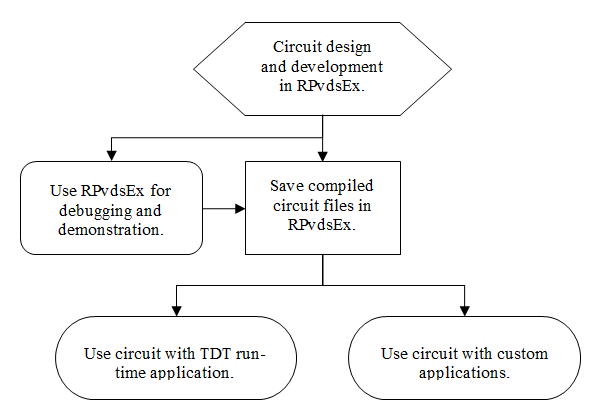 |
| System 3 Design Path |
Higher-level software applications load the circuit to the hardware at run-time and give the user access to experimental parameters while the experiment is running.