
RZ5P Base Processor
Used in 302 published studies →
TDT’s RZ5P is the original processor for fiber photometry and is a base system for researchers with their own LED drivers, LEDs, and photoreceivers for calcium imaging.
Check Out the Latest in Fiber Photometry
The LUX RZ10X
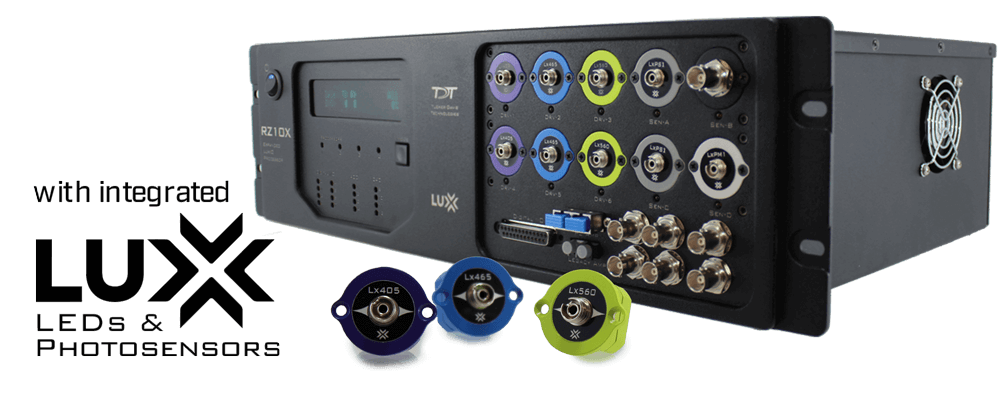
Watch the TDT webinar on the RZ10X to learn more.
TDT also has an upgrade pathway for existing RZ5Ps.
Product Specs
Resources
Publications
- Real-time lock-in amplification
- Four analog inputs and outputs
- 24-bit digital I/O
PDF RZ5P Processor: Fiber Photometry Recordings Fast Facts
Publications
302 published studies used the RZ5P. The newest:
Communications Biology · Nov 2026
Hippocampal somatostatin neurons gate context generalization during fear memory updating (opens in a new tab)
Nature Communications · Oct 2026
Dynorphin counteracts excitatory co-transmission in a lateral hypothalamus–locus coeruleus circuit underlying stress-induced anxiety (opens in a new tab)
Abstract
Anxiety disorders are highly prevalent, yet the circuit mechanisms linking stress to pathological anxiety remain incompletely understood. The locus coeruleus (LC), the brain’s primary noradrenaline source, receives dense innervation from the lateral hypothalamus (LH). Here, we investigate the LH prodynorphin→LC noradrenergic (LHdyn→LCNA) pathway in stress-induced anxiety. We find that restraint stress activates LHdyn neurons, which form monosynaptic connections onto LCNA neurons. In male mice, chemogenetic activation of this pathway promotes anxiety-like behavior—an effect attenuated by intra-LC orexin receptor blockade but exacerbated by kappa opioid receptor antagonism, indicating that co-released dynorphin acts as an intrinsic anxiolytic brake. Conversely, chemogenetic inhibition is anxiogenic in naïve male mice yet anxiolytic after chronic restraint stress. Using genetically encoded sensors, we show that dynorphin and glutamate are co-released in the LC, and that elevating dynorphin tone suppresses LCNA hyperactivity and reduces anxiety. These findings reveal a push–pull mechanism wherein excitatory transmission is intrinsically balanced by co-released dynorphin, offering a framework for understanding stress-related psychopathology. The locus coeruleus, the brain’s main source of noradrenaline, helps regulate stress responses. Here, authors show that dynorphin co-released from lateral hypothalamus neurons acts as an anxiolytic brake in the locus coeruleus, balancing excitatory signals to control stress-induced anxiety in mice.
bioRxiv* · Oct 2026
Striatal D2-neurons gate D1-mediated associative encoding under uncertainty (opens in a new tab)
Abstract
Goal-directed actions are established through the encoding of predictive relationships between behaviour and its consequences, a process involving dopamine-dependent plasticity in the dorsal striatum. Early phases of learning entail complex associative landscapes from which useful action-outcome contingencies must be identified. Although dopamine processes are central to associative learning, the cellular mechanisms through which behaviourally relevant plasticity is selected from competing signalling events remain unknown. Here we show that D2-spiny projection neurons (D2-SPNs) are transiently recruited during the earliest stages of instrumental learning, when critical action-outcome contingencies emerge. We identify a dominant cell-to-cell transmodulation process by which D2-SPNs regulate dopamine-dependent signalling by constraining protein kinase A activity in D1-SPNs. This mechanism overrides extracellular dopamine signals and can be reproduced in vivo through calibrated optogenetic activation of cAMP signalling. Enhancing D2→D1-SPN transmodulation during uncertain reinforcement schedules durably improves action-outcome encoding, revealing a mechanism through which striatal networks promote relevant contingencies under associative ambiguity.
* Preprint: not yet peer reviewed.
How to cite the RZ5P
Name the model in your Methods so readers can find the equipment you used, for example:
RZ5P Base Processor (Tucker-Davis Technologies, Alachua, FL, USA)