Menu

16 and 32 Channel Ephys

A Streamlined and Effective Analog Recording System

Overview

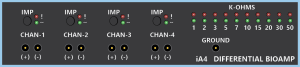
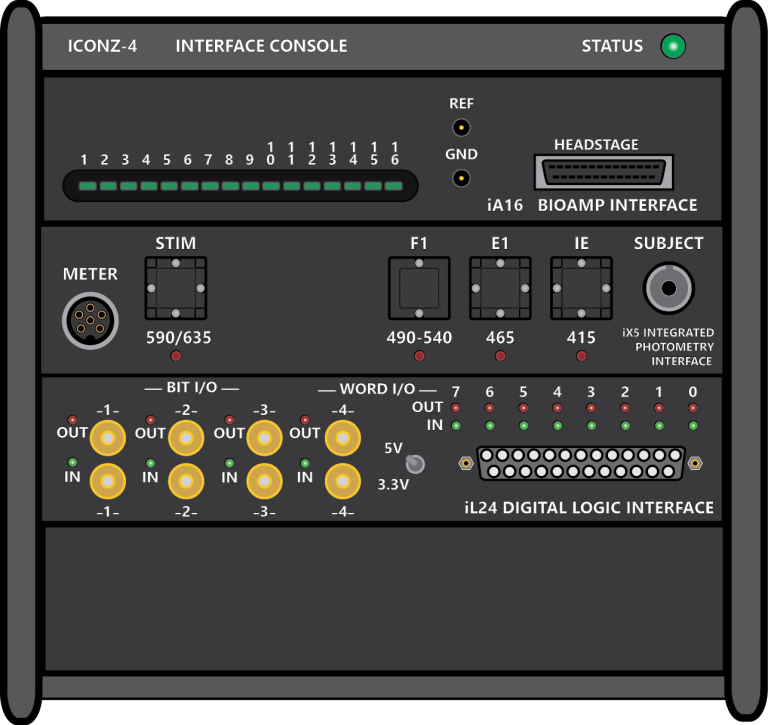
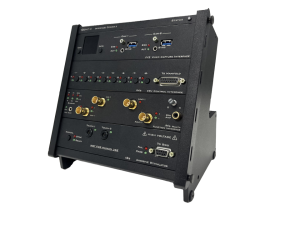
TDT analog amplifiers are the gold-standard in electrophysiology, and it has never been easier or more affordable. Perform high-resolution, high input range recordings up to 25 kHz with the iA16 or iA32 Bioamps inside an iConQZ interface console.

Each low-noise amplifier is biomedically and ground/reference isolated, so noise is easy to troubleshoot and you can record from multiple probe sites on the same subject. Reference inputs can also be configured to use a dedicated reference electrode, single-ended ground as reference, or true differential recordings.
Get a Quote Started Today

Pre-configured systems

Starting points our application scientists recommend. Every setup can be changed or expanded; tell us about your experiment and we will adapt it.

Most Popular

32 Channel Ephys + Video

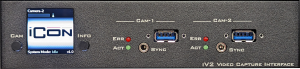
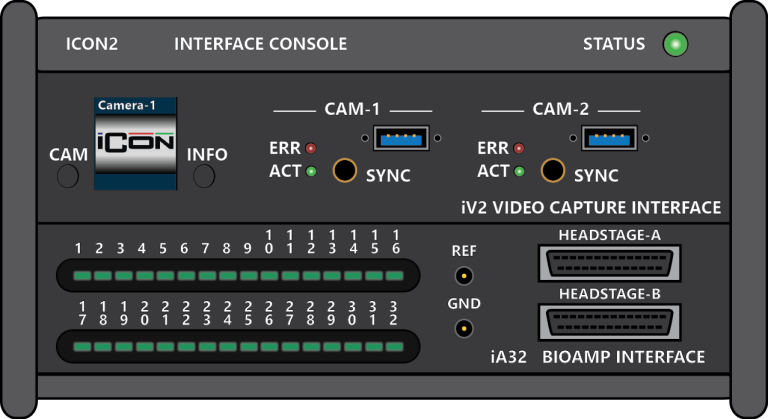
A 32-channel analog recording system offering the ideal setup for silicon arrays, depth probes, and high-density ECoG arrays. The iA32 provides a 24-bit signal resolution and a large input range with DC recording capability for spike and LFP recordings. The iV2 adds dual-camera video with real-time tracking for closed-loop behavioral feedback.

Includes

Quote this setup

16 Channel Ephys + Photometry + Opto + Digital IO

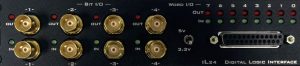
A 16-channel ephys system that lets users perform photometry with an optrode or at a separate site for a more comprehensive study of neural circuits. This system also includes an iL24 for digital I/O TTLs to synchronize with or trigger third-party equipment.

Includes

Quote this setup

Published research: Electrophysiology

The newest papers in Electrophysiology that used TDT systems.

See all 3,104 papers →
bioRxiv* · 2026

An LFP-based characterization of population-level heterogeneity during motor preparation & execution

DePass M, Quessy S, Falaki A, … Cos I

The goal of the present work is to characterize mesoscale heterogeneity of population-level neural activity in the motor areas during motor preparation and execution using high-frequency local field potentials (HF-LFPs). Understanding the distribution of neural activity at this scale is necessary since ensembles of neural populations underlie most behaviors. HF-LFPs have emerged as a promising signal for such analysis due to their stability and relationship with cortical population dynamics. Here we analyzed HF-LFPs in non-human primates performing a reach-to-grasp task. We quantified three complementary aspects of heterogeneity: variance, latent dimensionality, and directional coherence. Heterogeneity varied by region and neuromotor state, and was specific to the motor behavior being implemented, even in regions exhibiting high correlation. In addition, more heterogeneous activity tended to better encode neuromotor states. Namely, regions and neuromotor states exhibiting higher variance and dimensionality yielded superior motor decoding performance. Further analyses involving low-dimensional linear projections of the signals revealed rich intra-region interactions between ensembles of populations. The present work helps establish intra-region heterogeneity as a multi-faceted and informative measure of neural activity, even on small spatial scales. It also establishes HF-LFPs as an effective signal for capturing complex intra-region dynamics, making it a suitable candidate for multi-region, systems-level analysis. Significance Statement Though the motor system has most often been investigated through analyses of spike patterns of individual neurons, most behaviors require coordination at the level of neural populations. Recent work suggests HF-LFPs capture cortical population-level dynamics, making them apt for the characterization of neural activity at this scale. Here we analyze HF-LFP from two non-human primates, recorded during a reach-to-grasp task. Our results reveal intra-region, population-level activity that evolves over the course of motor preparation and execution. Moreover, we show that the heterogeneity of population-level activity is multifaceted and associated with motor decoding accuracy. These results are of potential interest both for future research of population-level activity and for BCI applications.

Read the paper → (An LFP-based characterization of population-level heterogeneity during motor preparation & execution, opens in a new tab)
Brain Research Bulletin · 2026

State-separated analysis for L-DOPA response in hemiparkinsonian 6-OHDA rats

Kim J, Kang S, Park JW, … Choi JW

Analysis of responses to L-3,4-dihydroxyphenylalanine (L-DOPA) in hemiparkinsonian rodent models can enhance understanding of Parkinson's disease (PD). Traditionally, these responses have been classified into medication OFF and ON states, with ON defined as the period after sufficient time has elapsed following drug administration. However, this binary classification may lead to neurophysiological analyses that overlook interindividual variability in the onset and duration of therapeutic effects. Although measuring plasma L-DOPA concentrations has been proposed to quantify this variability, technical difficulties in direct measurement limit the application of this approach. Here, we investigated whether acute L-DOPA responses can be quantitatively distinguished into behavioral states without direct plasma measurements, and whether these states correspond to neurophysiological dynamics. Using quantitative analysis of rotation direction in hemiparkinsonian rat model, we classified L-DOPA responses into four temporally distinct states: OFF, early contralateral rotation (ECR), rotational pause (RP), and late contralateral rotation (LCR). These behaviorally defined states exhibited statistically distinct neurophysiological profiles, characterized by simultaneously measured subthalamic firing rates and striatal dopamine levels. Although single-unit activity was insufficient to decode state transitions, neural population activity enabled robust decoding via a support vector machine (SVM). Furthermore, linear dynamical system modeling revealed transition-specific trajectories in a low-dimensional state space, suggesting that state transitions are represented by coordinated population dynamics. These findings demonstrate that temporal variability in L-DOPA responses can be identified behaviorally, providing a neurophysiologically validated framework that extends the conventional binary classification into a multi-state transition for PD research.

Read the paper → (State-separated analysis for L-DOPA response in hemiparkinsonian 6-OHDA rats, opens in a new tab)
iScience · 2026

Astrocytes improve tactile categorization by modulating sensory processing in neurons.

Alejandra Calero-Vargas, Frida Higinio-Rodríguez, Rafael Olivares-Moreno, … Mónica López-Hidalgo

Astrocytes are active elements in sensory processing; however, it remains unclear whether they contribute to the perception and categorization of sensory stimuli. Specifically, whether astrocytes in the secondary somatosensory cortex (S2), a higher-order cortical area whose neuronal activity underlies perceptual choices, actively contribute to this process is unknown. Here, we show that chemogenetic modulation of S2 astrocytes improves mice's performance on a categorization task. Calcium imaging shows that S2 astrocytes respond to vibrotactile stimuli in a nonlinear manner, comprising selective, variable, and inhibited response profiles. Furthermore, chemogenetic modulation of S2 astrocytes…

Read the paper → (Astrocytes improve tactile categorization by modulating sensory processing in neurons., opens in a new tab)

* Preprint: not yet peer reviewed.

Low Noise, High Resolution Recordings

High Fidelity Amplifiers

The iA16 and iA32 iCon amplifiers follow the legacy of precision TDT engineering with their 24-bit resolution and over 100 dB of signal-to-noise.

Connect these to screws, ECoG arrays, silicon probes, tungsten electrodes, and more to acquire EEGs, LFPs, multi-units, and single-unit activity in vivo.

Chronic Freely Behaving Recordings

TDT’s ZIF-clip or Omnetics headstages can attach directly to a subject headmout or to ACO motorized commutator for continuous chronic recording experiments. Both options plug directly into the iA16 or iA32 amplifier banks for a clean recording setup.


Get recording right away

Synapse Software

Synapse is the ultimate software for neurophysiology experiment design, and setup of the iA16 or iA32 is very simple. You can configure the sampling rate and reference of your amplifier and immediately start recording. Signals are available in real-time for filtering and closed-loop feedback.

Build Your Perfect Ephys System

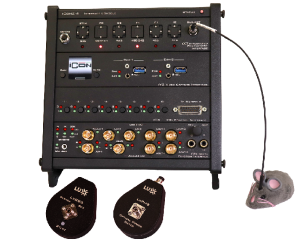
The iA16 and iA32 ephys amplifiers are just one piece of the perfect recording system. Our iCon platform lets users create customized systems to mix-and-match ephys, photometry, auditory, behavior, electrical stim, and more.

All the signals are synchronized and available together. TDT’s iCon is the only system that can do this.

Why TDT?

When you choose a TDT behavioral neuroscience recording system you choose legacy, innovation, and commitment. Every system is designed and assembled at our headquarters in Alachua, Florida by our long-time employees.