Menu

Behavior + Electrophysiology

Behavioral Control, Simplified

Overview

TDT has a single system for behavioral control and electrophysiology. Easily integrate behavioral events with electrophysiology for perfectly synchronized recordings.

The iCon communicates seamlessly with most third-party behavioral chambers through TDT’s family of RZ processors. Ensure perfect timing of neural signals and behavior with no data loss.

The iCon is programmed in the same software used for neurophysiology – Synapse.  The Pynapse Gizmo is a coding environment that controls the iCon and runs in Synapse. Easily design sophisticated state-based behavioral tasks with Pynapse.

View real-time neural activity and behavioral responses with TDT for rapid validation of your experimental protocol.


Get a Quote Started Today

Published research: Behavioral Neuroscience

The newest papers in Behavioral Neuroscience that used TDT systems.

See all 1,459 papers →
bioRxiv · 2026

Mice detect and discriminate temporal patterns of mesoscale optogenetic cortical stimulation

Gabrielle Stephens, Nikolas A. Francis

Optogenetic stimulation is widely used to establish causal links between neural activity, behavior, and sensory perception, yet animals may also perceive the neural stimulation itself, a phenomenon termed “optoception.” We hypothesized that cortical optogenetic stimulation would generate an artificial percept that could be distinguished from externally evoked sensations and characterized psychometrically in an operant task. We tested this hypothesis using mesoscale cortical photostimulation delivered by a 3 mm, 459 nm LED implanted over auditory cortex. Four mice expressing Channelrhodopsin-2 (ChR2) in excitatory neurons learned a head-fixed go/no-go task in which 20 Hz cortical photostimulation served as the target. ChR2-positive mice detected cortical photostimulation relative to LED-off catch trials, distinguished it from both an external LED matched in wavelength and pulse rate and from an acoustic noise matched in amplitude-modulation rate, and discriminated between 20- and 10-Hz cortical photostimulation. Reducing implanted-LED optical power initially lowered rate-discrimination sensitivity, which then increased across training sessions, demonstrating perceptual learning. In two mice tested with 11 randomly interleaved rates spanning 10-20 Hz, lick probability followed a saturating rate-dependent function. Two ChR2-negative littermates failed to acquire photostimulation-locked behavioral responding. Together, these findings show that mesoscale cortical optogenetic stimulation generates a graded, learnable artificial percept whose behavioral readout depends on photostimulation rate and optical power. This single-LED preparation provides a cost-efficient and wavelength-extensible platform for psychometric analysis of optoception. SIGNIFICANCE STATEMENT Optogenetic stimulation can alter sensory processing, but the neural perturbation itself may also become a perceptual cue. We show that mice detect mesoscale cortical photostimulation delivered by a 3 mm implanted LED, distinguish it from matched external light and sound, and discriminate differences in photostimulation rate. When implanted-LED optical power was reduced, discrimination sensitivity initially declined and then increased across training sessions, revealing perceptual learning of optoception. Thus, mesoscale cortical photostimulation generates a graded internal signal whose behavioral readout depends on stimulation rate, optical power, and experience. A single implanted LED provides a cost- efficient and wavelength-extensible assay for measuring optogenetic perception.

Read the paper → (Mice detect and discriminate temporal patterns of mesoscale optogenetic cortical stimulation, opens in a new tab)
bioRxiv · 2026

Central lipid sensing tunes accumbal D2R-neuron activity in appetitive behaviours

Guangping Li, Julien Castel, Anthony Ansoult, … Serge Luquet

Energy homeostasis and motivated behaviours are tightly interconnected processes coordinated by peripheral metabolic signals and central reward circuits. Among these signals, circulating triglycerides (TG) have emerged as neuromodulators of mesolimbic dopamine functions and reward processing. However, whether TG directly regulate the activity of defined neuronal populations within the nucleus accumbens (NAc) during appetitive behaviours remains unknown. Here, we investigated how central TG availability shapes the in vivo activity of NAc dopamine D2 receptor-expressing spiny projection neurons (D2R-SPNs) across distinct nutritional and metabolic states. Using in vivo fiber photometry in Drd2 -Cre mice, we monitored D2R-SPN Ca 2+ dynamics during appetitive Pavlovian conditioning and refeeding. D2R-SPNs progressively developed robust responses to a reward-predictive conditioned stimulus (CS + ) over the course of learning, while their activity during reward consumption remained stable. Acute elevation of central TG levels through carotid infusion did not alter D2R-SPN activity or behavioural performance in lean chow-fed mice, irrespective of whether they were fed or food-restricted. In contrast, in mice exposed to a high-fat diet (HFD), central TG delivery suppressed cue-evoked D2R-SPN activity in food-restricted animals without affecting reward consumption or behavioural outputs. Likewise, TG significantly reduced refeeding-evoked D2R-SPN activation in fasted HFD-mice, while leaving novelty-induced neuronal responses unchanged. Together, these findings demonstrate that obesogenic conditions reveal a metabolic state-dependent sensitivity of accumbal D2R-SPNs to circulating lipids. This work identifies TG as context-dependent modulators of D2R-SPN function and uncovers a mechanism through which dietary history interacts with current metabolic state to reshape the neural encoding of reward-predictive cues and food-directed behaviours.

Read the paper → (Central lipid sensing tunes accumbal D2R-neuron activity in appetitive behaviours, opens in a new tab)
Developmental Neurobiology · 2026

Developmental Trajectory of Auditory Brainstem Deficits in a Mouse Model of Fetal Alcohol Spectrum Disorders

Michael Douchey, Stephanie Huntwork, Cassidy Sandstedt, Ragunathan Padmashri

Individuals with fetal alcohol spectrum disorders exhibit impaired auditory processing and atypical auditory behaviors across the disorder's spectrum. Although low to moderate prenatal alcohol exposure (PAE) is a prevalent type of exposure, the developmental trajectory of auditory processing deficits resulting from this level of exposure remains unknown. To examine the effects of PAE in the auditory system, we utilized the maternal voluntary alcohol consumption paradigm to model chronic low to moderate PAE throughout gestation. We measured auditory brainstem responses (ABRs) in juvenile mice (postnatal day 16–19) and longitudinally across early adolescence (4–5 weeks), late adolescence (7–8 weeks), and young adulthood (12–14 weeks). ABR abnormalities were first observed in juvenile PAE mice. The effects of PAE on brainstem auditory processing were most prominent in early adolescence, largely dissipated in late adolescence, and showed a reemergence in early adulthood. PAE mice showed elevated ABR thresholds, prolonged wave latencies, and reduced wave amplitudes. Ratios of ABR peak 3 relative to the first ABR peak indicated that the auditory brainstem pathways were hyperactive in PAE mice. The amplitude ratio was found to be elevated from early adolescence to early adulthood, suggesting that PAE has a persistent effect on auditory processing. We found a significant correlation between the amplitude ratios in early adolescent PAE mice and dam ethanol consumption, which point toward dose‐dependent brainstem gain dysregulation. Our study shows multilevel auditory alterations highlighting the vulnerability of central auditory pathways to PAE and fills an important gap in understanding auditory processing deficits in a clinically relevant exposure model.

Read the paper → (Developmental Trajectory of Auditory Brainstem Deficits in a Mouse Model of Fetal Alcohol Spectrum Disorders, opens in a new tab)

Behavioral Control with the iCon

The iCon is a simple-to-use behavioral control interface. The iCon has interchangeable modules to fit the needs of any experimental paradigm. Modules for the iCon include:

High Voltage Interface | iH10

For third-party devices requiring high voltage, such as food dispensers and lever presses

Multi-Function Interface | iM10

This analog I/O controls auditory speakers and microphones. The interface also has a touch sensor for lickometers

Other iCon modules are available for IR drivers and sensors (iR5) and digital logic (iL24).

Using the Pynapse Gizmo

Behavior and Neurophysiology in Synapse

Synapse is TDT’s all-in-one software to control and synchronize event-based behaviors with electrophysiology. Design sophisticated behavioral projects such as Go/No-Go paradigms and watch in real-time how behavioral responses alter neural firing rates.

Pynapse is Synapse’s embedded behavioral control Gizmo. Information from the behavioral rig (inputs, outputs, timers, etc.) is extracted into the Pynapse coding environment and built-in autocomplete assists with coding behavior paradigms.

Synapse is a single software for seamless integration of your event-based behavioral projects with neural recordings.

Neurophysiology Solutions

TDT provides a variety of ephys options for your behavioral neuroscience experiments.

Digitizing Headstage

Select TDT’s digitizing ZIF-clip headstage – with an integrated Intan chip – for your high channel count mouse studies.

Analog Amplifier

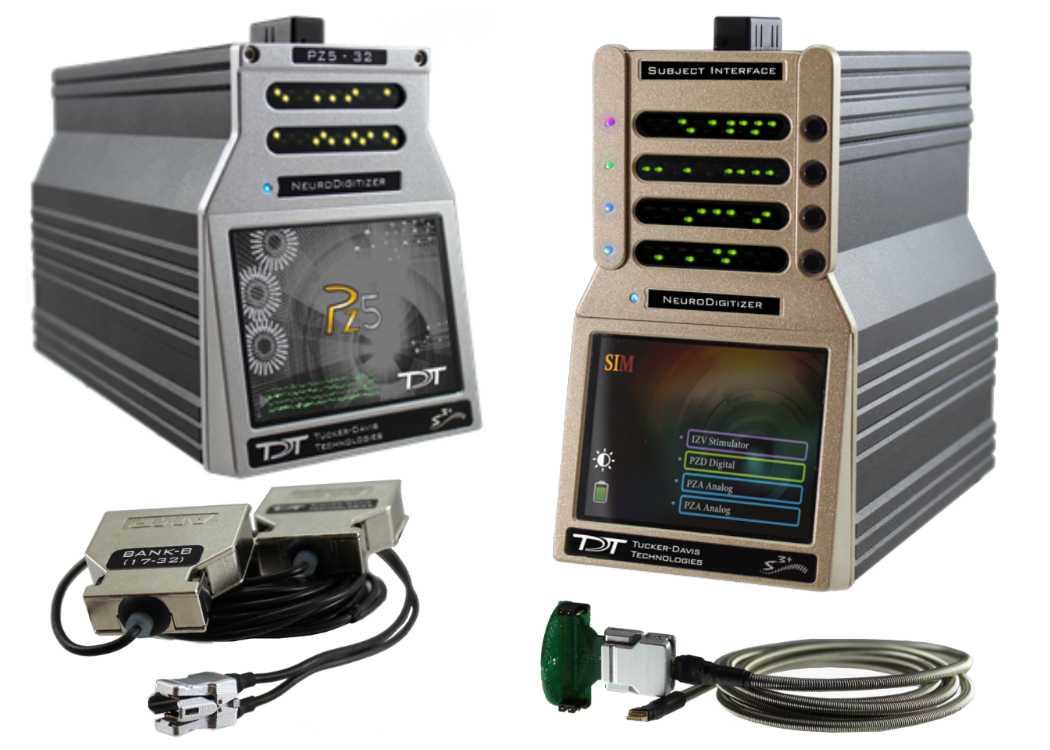
Or select TDT’s analog PZ5 amplifier and ZIF-clip headstages for high quality LFP and EEG recordings.

Electrical Stimulation

The Subject Interface expands on the PZ5 with the addition of dynamic electrical stimulation. Use the switching headstage to simultaneously stimulate and record through the same electrode array.