
Menu

Behavioral Control

A Complete Behavioral Neuroscience System

Overview

Behavioral control experiments are an important tool in neuroscience research for studying decision-making, learning, addiction, conditioning, and much more. TDT’s iCon platform, with its modular hardware components, can handle all aspects of operant behavior: delivering rewards, detecting responses, controlling cues, and time stamping events with microsecond precision.

Operant behavior is also easy to pair with neural recordings such as fiber photometry or electrophysiology. TDT’s iCon system provides a complete, integrated solution for operant behavior control that synchronizes perfectly with neural recordings without any jitter or post-processing alignment.
Get a Quote Started Today

Published research: Behavioral Neuroscience

The newest papers in Behavioral Neuroscience that used TDT systems.

See all 539 papers →
bioRxiv* · 2026

An LFP-based characterization of population-level heterogeneity during motor preparation & execution

DePass M, Quessy S, Falaki A, … Cos I

The goal of the present work is to characterize mesoscale heterogeneity of population-level neural activity in the motor areas during motor preparation and execution using high-frequency local field potentials (HF-LFPs). Understanding the distribution of neural activity at this scale is necessary since ensembles of neural populations underlie most behaviors. HF-LFPs have emerged as a promising signal for such analysis due to their stability and relationship with cortical population dynamics. Here we analyzed HF-LFPs in non-human primates performing a reach-to-grasp task. We quantified three complementary aspects of heterogeneity: variance, latent dimensionality, and directional coherence. Heterogeneity varied by region and neuromotor state, and was specific to the motor behavior being implemented, even in regions exhibiting high correlation. In addition, more heterogeneous activity tended to better encode neuromotor states. Namely, regions and neuromotor states exhibiting higher variance and dimensionality yielded superior motor decoding performance. Further analyses involving low-dimensional linear projections of the signals revealed rich intra-region interactions between ensembles of populations. The present work helps establish intra-region heterogeneity as a multi-faceted and informative measure of neural activity, even on small spatial scales. It also establishes HF-LFPs as an effective signal for capturing complex intra-region dynamics, making it a suitable candidate for multi-region, systems-level analysis. Significance Statement Though the motor system has most often been investigated through analyses of spike patterns of individual neurons, most behaviors require coordination at the level of neural populations. Recent work suggests HF-LFPs capture cortical population-level dynamics, making them apt for the characterization of neural activity at this scale. Here we analyze HF-LFP from two non-human primates, recorded during a reach-to-grasp task. Our results reveal intra-region, population-level activity that evolves over the course of motor preparation and execution. Moreover, we show that the heterogeneity of population-level activity is multifaceted and associated with motor decoding accuracy. These results are of potential interest both for future research of population-level activity and for BCI applications.

Read the paper → (An LFP-based characterization of population-level heterogeneity during motor preparation & execution, opens in a new tab)
bioRxiv* · 2026

Dissociable norepinephrine and dopamine representations during strategic decision-making and reward learning

Aloor J, Sit TP, Geuter J, … Duan CA

Adaptive decision-making in competitive environments requires learning from immediate reward outcomes while tracking longer-timescale information to adjust behavioural strategies and remain unpredictable against others. Dopamine (DA) and norepinephrine (NE) have long been implicated in reward-guided behaviours, but their contributions to strategic choice remain unclear. We trained mice to play a zero-sum matching pennies game against a computer opponent that exploited regularities in their choice and reward history, such that optimal performance required stochastic choice decoupled from immediate reward. We combined fibre photometry recordings, behavioural and neural modelling, and a within-subject multi-task design to determine how NE and DA contribute to strategic choice in the matching pennies game versus reward-guided behaviour in a two-armed bandit (2AB) task. DA responses were dominated by trial-by-trial reward outcomes and consistently tracked model-derived reward prediction errors (RPE) across tasks and behavioural states. In contrast, NE activity reflected salient task events, predicted upcoming choice switches, and tracked longer-timescale variables including model-inferred behavioural strategy and average reward rate. In addition, NE responses were selectively enhanced following rewarded switches when these outcomes were informative for deciding whether to stay in or switch from the current strategy; and this enhancement could not be explained by RPE. Incorporating pre-choice NE activity into a reinforcement-learning model to modulate choice generation improved model prediction in matching pennies but not in the 2AB task. Together, these findings reveal complementary neuromodulatory correlates of competitive decision-making across timescales: DA primarily guides learning from immediate outcomes through RPE, whereas NE additionally represents contextual information and choice stochasticity relevant for shaping long-term strategies.

Read the paper → (Dissociable norepinephrine and dopamine representations during strategic decision-making and reward learning, opens in a new tab)
European Journal of Pain (London, England) · 2026

Pain Enhances the Auditory P2 but Attenuates Mismatch Response and P3a.

Alexandre Lehmann, Marc Schönwiesner, Pierre Rainville

Background Auditory input is known to modulate the perception of pain, yet the reciprocal influence, how pain affects auditory processing, remains less well understood. We investigated how continuous tonic pain dynamically alters auditory cortical responses in humans. Methods Using a three-stimulus auditory oddball paradigm combined with EEG, we recorded event-related potentials (ERPs) while participants experienced thermal stimulation under three conditions: baseline, non-painful warmth, and pain. We examined multiple stages of auditory processing, including early sensory encoding (N1, P2), automatic deviance detection (MMN), and attentional reorienting (P3a). Results Tonic pain modulated a…

Read the paper → (Pain Enhances the Auditory P2 but Attenuates Mismatch Response and P3a., opens in a new tab)

* Preprint: not yet peer reviewed.

BEHAVIORAL CONTROL WITH THE ICON

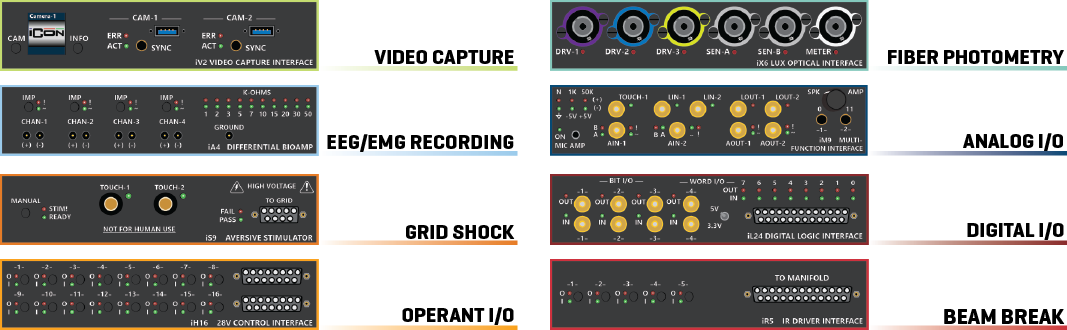
The iCon can be configured with any number of specialized modules for complete behavioral neuroscience recordings:

  • iH8/iH16: Output controllers for operant behavioral cage components (MedAssociates, Lafayette, Pan Labs, Harvard Apparatus)
  • iR5/iR10: Ifrared beam break interface for subject tracking
  • iS9: Aversive stimulation module for grid shock
  • iL24: Digital I/O for TTL signals and event time stamping
  • iMn: Analog I/O modules for speaker control and signal input capture

All modules integrate seamlessly with Synapse software for experiment design and real-time control.

iCon module list

Easy State Control with Pynapse

Behavior in Synapse

Pynapse is TDT’s Python-based state machine environment for designing operant behavior experiments. It provides a powerful yet intuitive framework for creating complex behavioral paradigms with real-time iCon module integration. Any paradigm that can be drawn out as a flow diagram can be easily coded in Pynapse. Users can trigger states based on inputs to iCon modules, such as a lever press, and jump to states based on conditional criteria such as timeouts, correct or incorrect nose pokes in response to a tone, and much more.

Key Pynapse features:

  • State-machine logic for behavioral paradigms
  • Real-time closed-loop control with neural signals
  • Built-in plotting and data visualization
  • Python scripting for unlimited flexibility
  • Seamless integration with Synapse recording

The iPac Behavioral Controller

High Recording Throughput

The iPac is a system for high throughput behavioral neuroscience, allowing you to run up to 8 behavioral experiments at the same time.

Manage all of your behavior boxes concurrently with independent behavioral paradigms. For example, control a self administration task in one chamber and a startle response in another.

Train subjects with the iPac and then seamlessly migrate your experimental animal to integrate with your fiber photometry or other neuroscience techniques, or scale up your behavioral neuroscience projects by running multiple paradigms and subjects at once.

The iCon Platform

Welcome to TDT’s exciting new step into the future of neuroscience hardware and behavioral control.

The iCon is a unique hardware and software platform designed for users to do build-out and perform any applications they need for their experiments all in one place.


Any module combination can be used to make an iCon, which means we can provide customers with a mix-and-match setup that provides broad coverage for many experimental designs but no redundancies. This also means that you get the most value out of your system for the lowest cost.


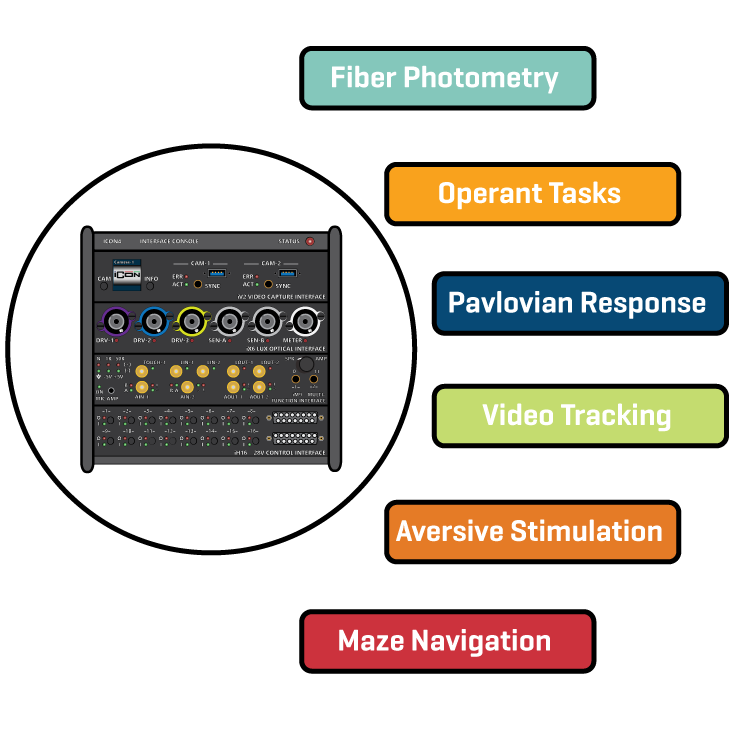
TDT currently has over 20 modules available to perform operant control, fiber photometry, low and high channel count electrophysiology, video tracking, sound presentation, aversive stimulation, general digital and analog input/output (IO), and many other neuroscience tasks. We are also constantly designing new modules for future additions to the platform.


Plus, teaching new students to use the equipment is streamlined and easy. But if you need any help, our dedicated support team are with you every step of the way at no extra cost. Lastly, everything is controlled, time-synchronized, and saved by our Synapse software, so you can design experiments and record multi-faceted data with no extra hassle.


All images of animals include artwork (modified or otherwise) from BioRender.